Web of Poverty
Date Posted: Apr 14, 2026.
How can the web of poverty help us understand the interconnected challenges that individuals face, and shape our responses to poverty?
We put these questions to Jessica Foster, Head of Church Engagement at Trussell, and asked her to suggest some practical steps that churches can take in response. Trussell's UK-wide community of food banks support people facing hunger and hardship – which are closely linked to poverty.
First, what do we mean when we talk about poverty?
Poverty is a complex problem that can be measured and discussed in all sorts of ways. It extends far beyond a lack of material resources to include isolation and self-esteem, and these factors feed each other.
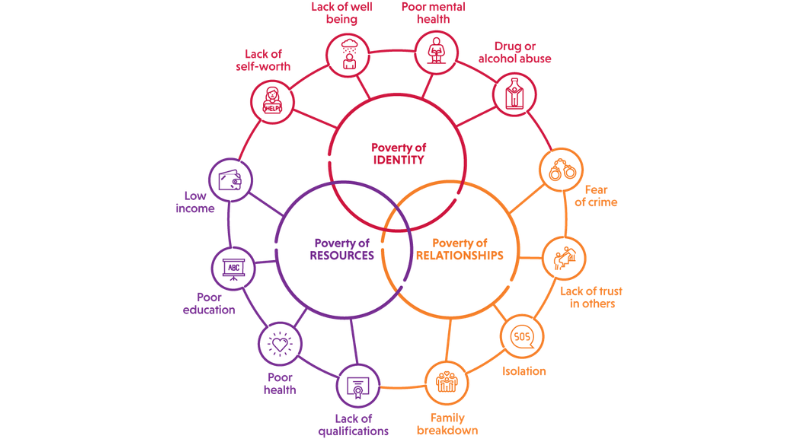
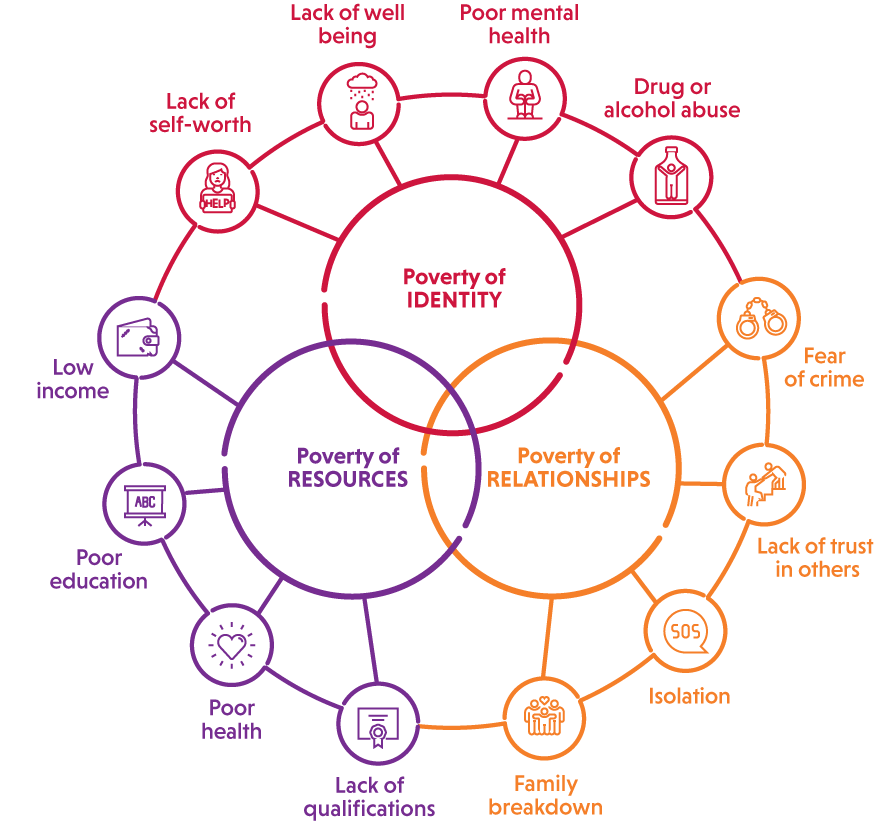
It can be helpful to imagine poverty as a web of interconnected challenges that significantly impact an individual’s or a community’s ability to thrive.
1 in 5 of the people sat in your church every week live in poverty [1]
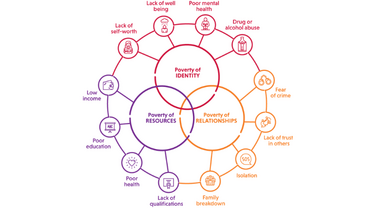
How helpful is the web of poverty as a framework?
Jess told us: “The web of poverty is really helpful, because it shows the impact of poverty as well as the causes, and it illustrates that poverty is more than about finances.
It’s also about relationships and identity.
“For example, more than a quarter of people coming to a food bank hadn’t had a conversation with a friend or family member for a month. [2] You can understand how not having enough money would mean that you wouldn't invite people to your own home, couldn’t socialise, or afford travel costs, leading to you becoming more and more isolated.
And poverty of relationships can worsen material poverty. Many people find work through their community or networks. If you don’t have those relationships, you’re much less likely to find work and therefore much more likely to remain facing poverty.
Depriving people of vital connections and opportunities for growth and well-being.
“I find poverty of identity is harder to grasp, but a friend of mine once said you need two things: purpose, and belonging. I think that’s really interesting…purpose is part of a healthy identity, and belonging speaks to the importance of relationships.
Poverty of relationships is:
- social isolation
- lack of belonging
- limited access to supportive networks and resources
Poverty of identity is: when people lack self-worth and a belief in their ability to overcome challenges. This can lead to low self-esteem, a lack of resilience and aspiration, poor mental health and low emotional well-being.
“However, while the causes and impact of poverty are interconnected, the driver or the root is usually lack of resources.[3] This leads to people feeling they have very little agency. Lack of resource has an impact on all those other factors like accessing mental health support, taking time off if you’re unwell or having savings to fall back if you lose your job.
How can the web of poverty shape the way churches respond to need?
Making space
“Alongside making sure people have enough money to live on, creating spaces where people find belonging and community can be a game-changer and shift things dramatically.
“While projects to support people practically are essential for as long as they are needed, it’s really important that you have community. And then becoming involved and having opportunities for participation can be a route to finding purpose and belonging.
“I can think of a church where you go along to a coffee morning and you don’t know who’s a volunteer, who’s a food bank guest, who’s come to do the gardening. And, actually, people might be all three. Everyone is participating. It is one community. There isn't any division between the people who are serving and the people who are being served.
“What churches can do is provide a space for people to gather, and encounter, and then the other things happen as they need to happen.
“But the primary motive, and what churches are often well placed to do, is to build community.
Closing the gaps
“I also think that churches can pay attention to the gap that often exists between the people at the front – the vicars, readers, deans – and the congregation, and how to close this up. So, people at the front:
- talking about their own mental health struggles
- making talks accessible, including the examples used
- sharing a range of different voices and experiences
CUF has some great resources for helping churches develop a more participatory culture.
“There’s also something about being intentional about crossing class and ethnic divides. There’s a lot of community and goodwill in churches and neighbourhoods, and I’ve learnt so much from people from different backgrounds and different faiths to me.
“I think the other thing we’re not talking about is class, another significant aspect that shapes people’s opportunities, support networks, connections and financial resilience. I think the Church is sometimes seen as a middle-class church for middle class people. I know the Church of England is doing some work around working class vocations, but that needs to really come through and have an impact on who gets recruited and promoted.
“All of us benefit from friendships that cross divides and this is particularly important when it feels like identity is being used to turn people against each other and to incite division and hatred.
‘There is neither Jew nor Gentile, neither slave nor free, nor is there male and female, for you are all one in Christ Jesus.’ Galatians 3:28
Opening the doors
Sometimes those of us that go to church may think that no-one wants to join in – especially if we are seeing declining numbers and feel the constant financial pressures. It might take a mind shift to see what we have got to offer to our neighbours.
What is church about? Church is about community, being a body and loving our neighbourhood. This needs to include having really porous boundaries where people can belong for as long as they want. We need to make being a community for more than a couple of hours a week much more normal.
“A model we’ve found works that really well is to build around an existing service, like a food bank. So that might mean offering a lunch, and inviting someone from Mind or a debt advice service, or a GP. Or finding ways to offer education or employment opportunities. It’s about encouraging people to look in the round at the range of issues that might be facing people.
“It's not really much of a community if it's just a Sunday service and a quick cup of coffee.
- - 1 in 7 people in the UK are facing hunger.[4]
- 1 in 4 people will experience a mental health problem of some kind each year in England[5]
- Social disconnection increases the risk of death, with loneliness leading to 871,000 deaths worldwide each year. Social disconnection can also lead to heart disease, stroke, depression, and anxiety.[6]
Poverty is a justice issue
“Through my work I often hear unhelpful language, assumptions and misconceptions about why people are living in poverty. People hear and read things that imply the deserving and undeserving poor that create stigma.
When Jesus quotes Isaiah to say: “I have come to bring good news to the poor”, he is beginning a ministry that is relational, where he eats with and lives alongside people facing hardship. However, phrases such as “the last, the least and the lost”, “the poor” or “the broken” are often used in our prayers, worship songs and liturgy as shorthand, or as a snappy phrase. They do not come with this relational emphasis, but instead label people struggling against hardship as one group without recognising individual identities and circumstances.
“I've heard people talk really powerfully about having to go to a food bank, and the shame and the difficulty in crossing that threshold… nobody wants to feel like they’ve failed in some way to feed their child. That's a horrible, horrible feeling.
But it’s the system that’s failed, not the individual. Social security is inadequate, Universal Credit is not enough to live on. So whatever you do, however well you budget, you're making really, really difficult decisions between heating, eating, and clothing your kids, because it's not enough.
“To me poverty is a justice issue like climate change, and asylum. It’s about an unjust system. It's the fourth mark of mission, and we need to work together to push for change.
“We’ve got some examples from the last few years of where we have made a difference. For example, the lifting of the two-child benefit cap which will pull 470,000 children out of severe hardship by 2027. [7]
‘He has told you, O man, what is good; and what does the Lord require of you but to act justly, love mercy, and walk humbly with your God?’ Micah 6:8
Coming back to the importance of community
“Churches can play a crucial role in addressing all aspects of the web of poverty, particularly building community and opportunities for connection. It’s important to think broadly about where to start and to build from relationships. From there you can co-create what else is needed. Find out together what has to be done for people’s wellbeing and survival, but also what people want to do for their community.
“And it’s also important to remember that all of us are part of this – we all have stuff to learn, we all have needs to be met and we all benefit from being part of a community.”
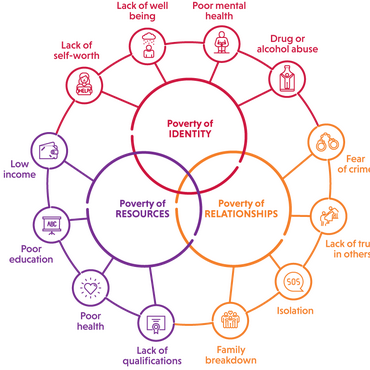
An introduction to the web of poverty
"Poverty isn't a line in the sand. It's a series of weblike snares which trap people and communities in life-limiting choices."
Reverend Jessica Foster
The Reverend Jessica Foster is a campaigner for social justice and inclusion, working with organisations and churches to bring about a more compassionate and equal society.
Jessica has recently contributed to 'Walking Humbly' a new resource from Trussell that enables church leaders to explore how people facing hunger and hardship can belong and participate fully in their church community.' CR Walking Humbly Leader's Booklet | Trussell Shop
She is an experienced speaker, host and facilitator with a passion for creating spaces in which all may be heard.
Jessica is an expert on interfaith relations with many years’ experience nationally and in the city of Birmingham, including pioneering CUF’s Near Neighbours programme, for which she was recognised by the Archbishop of Canterbury with a Lambeth Award.
Jessica was also awarded the King’s Coronation Medal in 2024 for her involvement in writing the service.
Jessica is Head of Church Engagement for Trussell, a community of food banks and anti-poverty charity.