“She’s got an ASBO” Challenging the labels of poverty
Date Posted: Aug 10, 2026.
I was a child living in a social housing estate when Anti-Social Behaviour Orders, or ASBOs, were introduced by New Labour in 1998. They were designed to reduce behaviours like harassment, vandalism, graffiti, joyriding and substance misuse. I remember incidents of anti-social behaviour, around the same time including a burnt out, still smouldering car in the church car park one morning when the bishop turned up for the priesting of our curate.
Although ASBOs were introduced to tackle anti-social behaviour, the term quickly entered popular culture as a stereotype and label, encouraging society to judge whole communities rather than individuals. Over a third of all ASBOs were issued to young people. This isn’t the first time that official labels and lazy assumptions have been applied to those living in poverty - in 1697, people receiving pensions were made to wear badges, to identify them as claimants of welfare support (1).
People who are in nice, middle-class areas can avoid social housing estates if they want to. They can drive past them, and don't have to engage with them. And then they see what's in the news and can build up a negative stereotype, having never actually been there.
I once decided to challenge someone who shared their views under a clickbait headline used by our local newspaper for a story based on the social housing estate where I grew up. I explained that I lived there and had achieved postgraduate qualifications. Their response was along the lines of ‘well, you’re clearly the exception to the rule.’

Supportive communities
Without minimising or sugar coating some of the real issues that exist within low-income communities, including criminal behaviour, living in an environment where lots of people have experienced personal challenges meant that the community support was a real strength. I encountered a lot of mutual support and trust – people willing to lend and borrow stuff. And honesty, and less judgement.
One example still makes me smile. I arrived home one day to find several people gathered outside my garden gate. One of my neighbours had heard someone screaming in my garden and come round to check I was OK. The person screaming turned out to be another neighbour who had chased a dog that was attacking her cat. Several other neighbours had then gathered because of the commotion. It was an odd moment, but it illustrated how willing people were to look out for one another. Thankfully all involved were ok following the incident.
The web of poverty
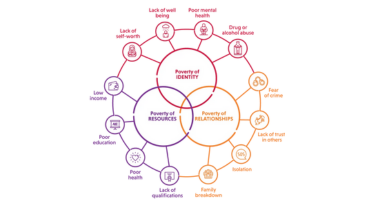
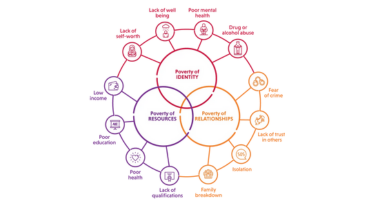
Poverty rarely has a single cause. Often those living in a social housing estate are doing so because the reputation means that the housing is cheap to rent, or they have received social housing from a council. Often these are people who need cheaper rent because they have experienced relationship breakdown, are fleeing domestic violence, are a single parent, have a health condition which prevents them from working, or simply can’t afford to live anywhere else.
Because the causes and impact of poverty are so interconnected, responses also need to be holistic and based on listening to what people need. I used to do some youth work in a secondary school where lots of the kids didn’t have access to a computer at home and would get into trouble for not completing homework that was set online. When we talked to the kids and discovered this, we secured funding to buy some laptops and offered an after-school club where they could complete their homework alongside providing tea and toast - in case school the next day was the next time that they would be able to eat.
We ran cooking courses for young people and invited the families of participants to come and eat too. This meant that we were teaching cooking skills and growing the confidence of the young people at the same time who were able to cook for their families. The meal each day became a shared meal where we were building relationships - and the most popular day was often the last day of the activity - also known as Roast Dinner Day.
Listening first, meeting practical needs, building trust, and being in it for the long term is so important to helping people find that sense of identity. As a youth worker I’ve supported young people over a number of years, through ups and downs – it’s not always easy but being there for them and guiding them and communicating that you value them. Over time you give them more responsibility. One of those young people I supported is now a youth worker herself!
It’s about giving people purpose and not making assumptions or limiting people based on where they’re from.
Come and see
Jesus himself experienced assumptions based on the place where he lived:
43 The next day Jesus decided to leave for Galilee. Finding Philip, he said to him, “Follow me.”
44 Philip, like Andrew and Peter, was from the town of Bethsaida. 45 Philip found Nathanael and told him, “We have found the one Moses wrote about in the Law, and about whom the prophets also wrote - Jesus of Nazareth, the son of Joseph.”
46 “Nazareth! Can anything good come from there?” Nathanael asked.
“Come and see,” said Philip. [John 1]
Nathanael asks if ‘anything good’ can come from Nazareth, tarring an entire place with an assumption, including that the Messiah couldn’t possibly have come from there.
God chose for his son to grow up in a place that people considered less than, perhaps demonstrating that we shouldn’t immediately write people off because of where they come from.
Philip’s response of ‘Come and see’, is one that I can wholeheartedly agree with. Places that are considered no-go areas are places that we as Christians should absolutely be going, because God doesn’t see them as no-go areas. We all need to have the opportunities to engage with different people from different experiences and backgrounds to us. Sometimes that will make us uncomfortable.
Perhaps the challenge is to pause when we encounter stories about places or people we think we already understand. We should ask, "Who's written this, and where's it come from, and is this actually what is happening?" And we should remain open to meeting people whose experiences differ from our own. It might, after all, make us uncomfortable – and change our assumptions.
I wonder if, from the title, and my mentioning that I grew up in a social housing estate, that you assumed the ‘she’ in the title with the ASBO was me? On this occasion, it’s our cat - at our vets, cats who are likely to bite the vet are given ‘ASBO’ warnings in their notes.
Dr Aimi King, Mission Support Lead in the Diocese of Leeds and Estates Evangelism Task Group National Project Lead



Further reading
(1) Steve Hindle (2004) Dependency, Shame and Belonging: Badging the Deserving Poor, c.1550-1750
Aimi King (2024) A case study of the faith motivations of clergy, staff and volunteers in church social action: https://pure.hud.ac.uk/en/studentTheses/a-case-study-of-the-faith-motivations-of-clergy-staff-and-volunte/
Mary O’Hara, (2020) ‘The Shame Game: Overturning the Toxic Poverty Narrative’ Policy Press