Embracing tensions, retaining hope: the future of Christian social action
Date Posted: Sept 17, 2026.
Embracing tensions, retaining hope: the future of Christian social action
Jon Kuhrt, CEO of Hope into Action
We are living in times of significant anxiety and anger. Consensus is breaking down, polarisation is breaking out. We see the evidence both online and on our streets. Wealth and property are held by ever fewer people, our housing crisis deepens and the tensions around immigration intensify.
These divisions are fuelled by social media corporations making vast sums through algorithms designed to appeal to our worst impulses, feeding us content curated to play on our insecurities, bloat our sense of righteousness and sustain a collective addiction to anger.
W.B. Yeats’ lines seem more relevant than ever: ‘Things fall apart; the centre cannot hold.’
Frontline
Church-based social action stands on the frontline of these tensions. We see the reality of poverty and the housing crisis, and the challenges facing both long-term residents in our communities and those who have arrived from other countries. We need to grapple honestly with what we see.
This is partly what conferences are for: to step back from the frontline and wrestle with the wider issues facing our communities. It is tempting for speakers to play it safe, to affirm, encourage or simply big up their own work. But if we don’t engage the real tensions, conferences become a bubble that leaves us less equipped for reality. When he worked for Housing Justice, Jacob Dimitrou put it sharply:
“Conferences in the charity sector are no longer places for ideas to be debated but where the same mantras are trotted out and organisational egos swell. This stifles the energy of the movement-based responses to social injustices.”
We need to stoke faith-filled energy, not stifle it. We need places where we can debate what a distinctively Christian response is and how to grapple with the tensions and challenges our communities face.
Below I share two models that help me hold the tensions of social action and outline three directions I believe they point us towards.
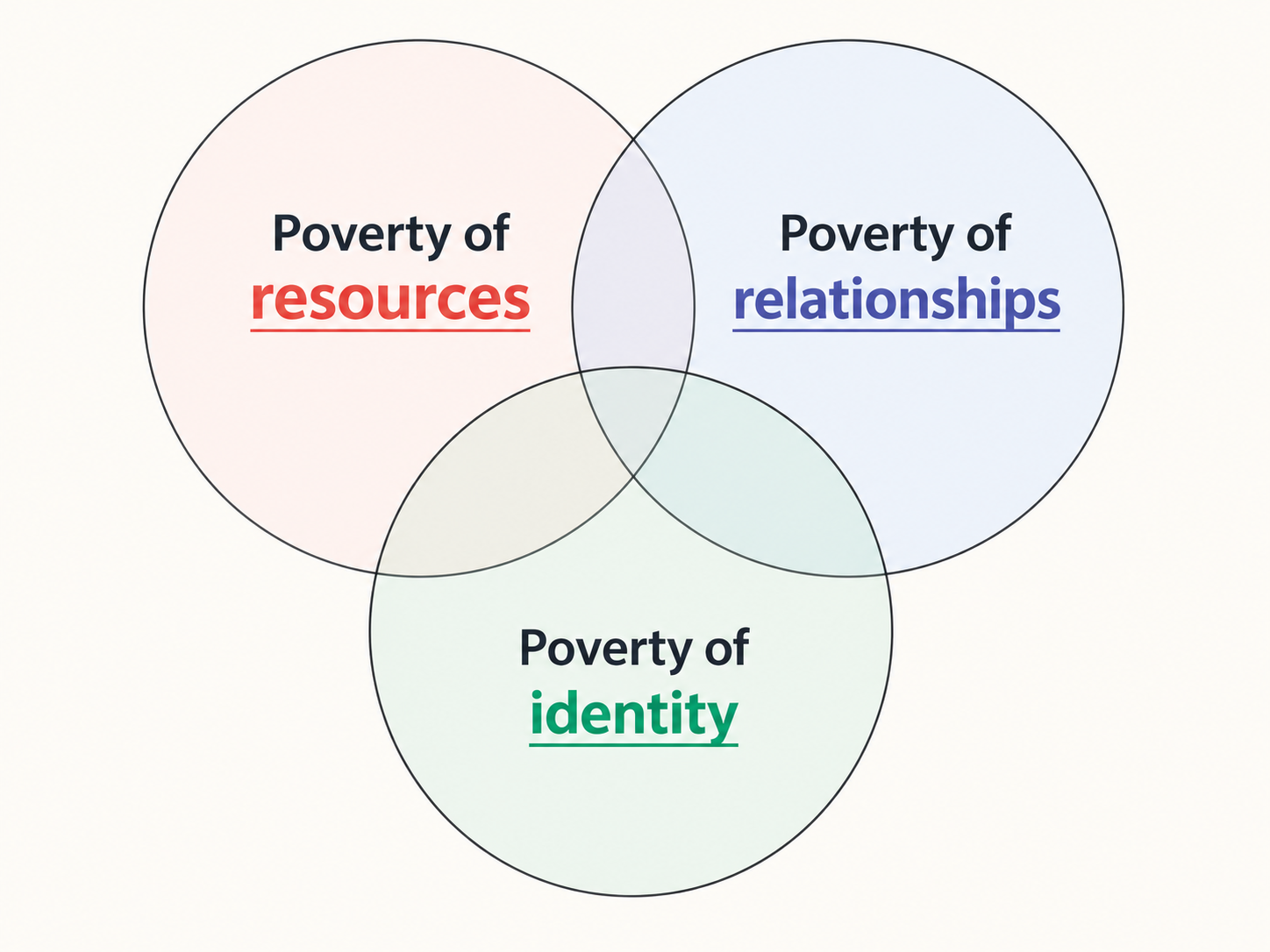
Poverty is a lack of resources: the cost of living, debt, unemployment and under-employment, the insecurity of zero-hours work, the lack of affordable housing. This is where structural injustice is most obvious.
But poverty is far more than material. There is a deep poverty of relationships in our communities, seen in family breakdown, neglectful parenting, domestic violence and abuse, as well as in basic isolation and loneliness. The ties that bind people together are fragile.
At the deepest level, poverty is also about identity and how we see ourselves. It is not only people’s relationships with others that are fragile but their relationship with themselves. Low self-esteem, mental health problems and the addictions so often connected to them all undermine a person’s very sense of self.
All three are interconnected. Long-term unemployment affects every one of them. An addiction can rob you of resources, ruin your relationships and scar your identity.
But this holistic understanding exposes tensions we do not always face. The liberal-left consensus, especially articulated at conferences and online, focuses almost entirely on the lack of resources and the structural injustice beneath it. Its weakness is that it can simplistically blame ‘the system’ for every ill in our society.
I saw this when I managed an emergency hostel for young homeless people in Soho. The charity I worked for produced report after report on the resources the government should release, but issues such as family breakdown was barely discussed, even though it was the biggest single cause of the young people’s homelessness.
We need to speak honestly about the part families and relationships play in wellbeing and in addressing poverty. Do we focus too much on giving out resources, rather than on how people build stronger relationships? Does a focus on ‘meeting needs’ serve to undermine someone’s identity, rather than strengthen their self-esteem and sense of agency?
Governments can make policy and distribute resources, but their reach is limited. Helping someone rebuild relationships, or recover a positive sense of identity, lies largely beyond the reach of the State. These are the areas of life that need families, friends, neighbours, churches and communities. This is where Christian social action can speak into with real conviction.
Holding grace and truth together
Second, we need to face the practical tensions that arise in any project seeking to help people or address poverty. It is naïve to pretend that compassion and kindness always produce good results. Our efforts to help often displace problems rather than address them, and our good intentions. Can easily be manipulated, creating unhealthy dependency.
Robert Lupton, the American Christian activist, put it starkly in his book, Toxic Charity: How Churches and Charities Hurt those they Help:‘I observed how quickly recipients’ response to charity devolved from gratitude, to expectation, to entitlement…where there was a sustained one-way giving, unwholesome dynamics and pathologies festered under the cover of kind-heartedness.’
For Lupton, the crucial distinction is between crisis problems and chronic ones. We often respond generously to stories of people in crisis, he argues, but most of our charity in fact goes to people facing predictable, solvable problems of chronic poverty. ‘An emergency response to chronic need is at best counterproductive and, over time, is actually harmful.’
So how do we keep serving without burning out, giving up or turning cynical?
I believe the answer lies in the balance of the two qualities that John’s Gospel says that Jesus is full of: ‘grace and truth’ (John 1:14). Together they offer a robust and practical theological framework for our action.
This chart has two columns that contrast the practical application of these qualities:
Emphasis on grace
Unconditional acceptance
Giving another chance
Showing compassion
Providing support and care
Advocating for people’s rights
Treated as a guest
Hospitality
‘Yes’
Emphasis on truth
Enforcement of rules
Maintaining boundaries
Administering justice
Challenging and empowering
Focus on personal responsibility
Treated as a client
Assessment
‘No’
Anyone who has run any form of social action knows that helping others is not just about the qualities in the left-hand column. Those characteristics are vital, but by themselves they are not enough. We need to integrate both columns and hold them in tension if we are to be effective.
This balance has been enormously important across thirty years of my work with people who are homeless. It has helped me make good decisions, hold boundaries, avoid burnout and stay focused on what is best for the people we serve, and it has also given my work solid theological foundations.
So often in social action we are responding to God’s call to love our neighbour. But a naïve or sentimental love will not last and will not serve people well. Grace and truth are the two key ingredients of a love that is robust, sustainable and transformative.
Three directions
In 2023 I wrote an article for Christianity magazine, The Sins of Social Action, critiquing three disconnections in contemporary social action.
First, the disconnection between charity and justice.
Secondly the problem of dependency, the disconnection with empowerment.
And thirdly the drift towards secularisation, the disconnection with faith.
The article provoked a lot of response, discussion and invitationss to speak further on these themes. It also led to a research project run by Together for the Common Good called Crossroads, which will be published soon.
In the three years since, I believe more than ever that these are the three directions that Christian social action should embrace:
1. Challenging power: justice and the political economy
Christian social action should not ignore the underlying drivers that trap people in poverty and create the needs that charity then aims to meet. Rather than simply acting as benefactors, which exacerbates class division, we should stand in solidarity with those trapped in poverty and together demand an economy less reliant on welfare and better able to generate decent, dignified employment.
The status of many jobs has changed, and work too often fails to deliver the dignity it should; people are reduced to units of labour, manipulated for profit. The philosophy driving this market dominance has been a disaster for stable community and family life; in effect, an assault on relationships. At the same time, our welfare arrangements have not incentivised work and have often imprisoned people in a trap where they are better off out of paid work. Both are signs of a broken and dehumanising political economy.
2. Changing practice: empowerment and the contributory principle
We must also be concerned with our own practice. Good intentions are not enough.
Is our approach to social action effective? Does our charity unintentionally trap people deeper in poverty? The uncomfortable truth is that too much of the growth in social action has focused on handing out resources rather than in forms of help that build mutuality, and I fear this is digging a bigger hole for the very people it seeks to serve.
Here too, a relational rather than transactional approach is fundamental. Relationships must be two-way, inviting people into environments where their contribution is a vital ingredient of the change taking place. A neat way of putting this is ‘the contributory principle’: all forms of social action should enable people to contribute to their own welfare and to the wellbeing of others.
3. Deepening spirituality: confidence in our distinctiveness
Thirdly, now is the time for confidence in what makes Christian social action distinctive. Many Christian charities have travelled a well-worn path of secularisation and in doing so have cut themselves off from their roots. We need a new emphasis on integrating faith alongside charitable activity, and we must resist diluting our distinctiveness until all that is left is a ‘legacy faith, where Christianity is just a footnote in a charity’s history rather than something dynamic and life-giving.
The needs of our communities are both deep spiritual needs of people affected by poverty. The scale of loneliness and despair is largely hidden from view. People in financial difficulty are the most likely to be living alone, and many have considered taking their own lives as a way out. We also know that spiritual accompaniment, offered respectfully as part of wider support, is very often welcomed.
‘The great disrupter’
I believe the radical founders of many Christian initiatives would be dismayed to see how the charities they began have been co-opted as secularised arms of the State. Too many charities are more focused on the size of their turnover than on societal change. I believe Christian social action needs to rediscover its prophetic edge, forged on our hope in Christ.
Being prophetic involves holding together what the world drives apart: justice, mercy and walking humbly with God. It means being willing to challenge across the boundaries of theological echo chambers and political tribalism.
We should be prepared to stand apart and challenge the status quo through political voice, practical action and prayerful discipleship. In the words of Jacob Dimitrou, ‘Christian social action should once again become the great disrupter’.
That means having a holistic understanding of both the material and relational poverty that plagues our nation.
It means calling for both structural change and personal responsibility. For a more just political economy and greater stability in family life.
It means acting with both grace and the truth towards those we serve. To proclaim good news of Christ and to live it out practically. To speak of both social justice and retain hope in the transforming name of Jesus.
Jon Kuhrt is CEO of Hope into Action and hosts the blog Grace + Truth